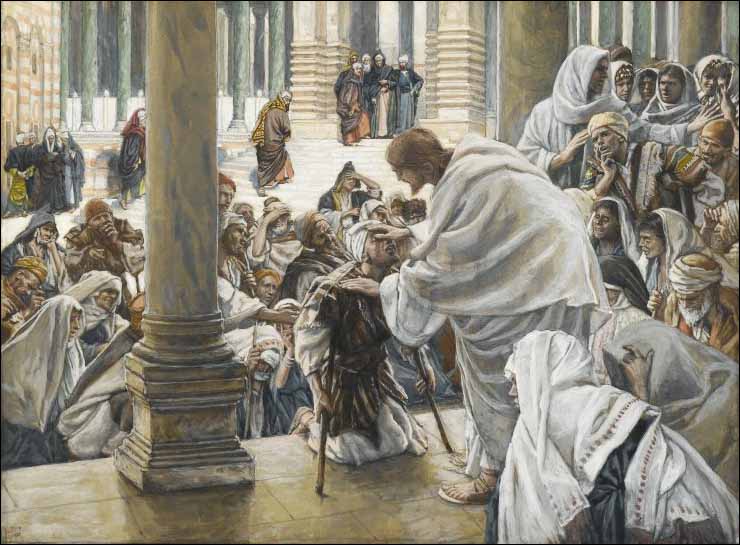
Jesus offended lots of people. He repulsed Israel’s leaders. Sometimes even his sympathizers found him disgusting. His actions embarrassed friends and enraged critics. On the Judean gossip vine, you were bound to hear the horrified gasp—“He did what?” Outrageous! Scandalous!
But what, exactly, was it about Jesus that kept stirring up a hornet’s nest? Oddly enough, it was love. We don’t usually think that love is particularly controversial. The people of Israel certainly believed that love is a good thing. The Law of Moses taught them to love God with their whole heart, and to love their neighbors as themselves. All Israel agreed with Jesus regarding these ideals. But the manner in which Jesus loved God and his neighbor was controversial, even explosive.
Let’s scan the Gospel of Matthew to understand the uproar that surrounded Jesus. He is remembered as both a great teacher and a great healer: “Jesus went throughout Galilee, teaching in their synagogues and proclaiming the good news of the kingdom and curing every disease and every sickness among the people. So his fame spread throughout all Syria, and they brought to him all the sick, those who were afflicted with various diseases and pains, demoniacs, epileptics, and paralytics, and he cured them” (Matt 4:23-24). Jesus proclaims good news (the announcement of long hoped for but now realized events) of the kingdom (the restoration of God’s rightful rule over a disordered world), and he exemplifies this right-now manifestation of God’s gracious presence by curing every disease (the oppressed are now reconciled to God).
Jewish belief commonly associated illness with sin and healing with forgiveness. Good health was seen as a mark of God’s blessing, and illness as an indication of his disfavor (Deut 7:15; 1 Sam 5:9; Ps 38:3; 41:1-4). So when Jesus heals the multitudes, including those outside the pale of Jewish respectability and thought to be under the divine curse, he is indiscriminately and controversially expanding the boundaries of God’s favor. It is significant that the earliest documented healings performed by Jesus (Matt 8) highlight an unclean leper, the servant of a despised Roman centurion, and exiled demoniacs.
Matthew’s most revealing account of Jesus’ healing ministry is recorded in Matthew 9, the cure of a paralyzed man. It is representative of the many healings that would follow in both the merciful action of Jesus and the hostile response of Israel’s leaders. When the paralyzed man is brought to Jesus, the first thing Jesus says is “Take heart, son; your sins are forgiven.” Immediately, the experts in the Jewish law declare, “This man is blaspheming.” What right does Jesus have to offer forgiveness outside the official rite of God’s temple and (even worse) to give such assurance to a physically accursed and ritually impure individual? Jesus responds that God has given him authority on earth to forgive and then cures the paralytic on the spot to prove it.
This miracle story is immediately followed by further controversy. Jesus and his disciples are mingling promiscuously with “tax collectors and sinners” at communal dinners. Shocked by this breach of religious etiquette, the Pharisees—who call themselves “separated ones” in reference to their strict social boundaries—challenge Jesus about his bad habit of keeping company with the unrighteous. Ignoring the scandal, Jesus replies, “Those who are well have no need of a physician, but those who are sick. Go and learn what this means, ‘I desire mercy, not sacrifice.’ For I have come to call not the righteous but sinners” (9:10-13).
After Jesus heals still others who are shunned by Israel’s guardians of purity (a dead girl, a woman with bloody discharges, blind beggars and more demoniacs), the Pharisees erupt. They are not willing to grant that their righteous God would side-step the Torah-certified Temple to bestow forgiveness on odious sinners. Such outcasts undoubtedly brought sickness upon themselves through wicked deeds. Therefore, they say, it must be by a demon power that Jesus works his miracles (9:34).
But Jesus is undeterred. The movement of divine reconciliation and healing will now expand as Jesus directs his disciples to participate in the mission. He sends out the twelve, saying: “As you go, proclaim the good news, ‘The kingdom of heaven has come near.’ Cure the sick, raise the dead, cleanse the lepers, cast out demons.” Jesus is sending them out “like sheep into the midst of wolves” and they will experience persecution just like their master. They must not shrink back from the scandal of divine mercy without borders. God’s kingdom is appearing here and now among the poor! The outrageous generosity of God will cause conflict and endanger the lives of the messengers. But they must not be afraid, for “whoever does not take up the cross and follow me is not worthy of me” (10:1-39). In Matthew’s Gospel, this is the first mention of the cross that will cast its ever growing shadow across Jesus’ path.
John the Baptist, imprisoned by King Herod, now sends messengers to Jesus. John has heard about the controversy that surrounds the Galilean who many believe to be the Messiah. Perhaps John, who proclaimed a message of fiery judgment against sin reminiscent of the prophet Jonah, is himself chagrined (again, like Jonah) by the seemingly liberal attitude Jesus takes toward sinners. John’s emissaries ask, “Are you the one who is to come, or are we to wait for another?” And Jesus answers, “Go and tell John what you hear and see: the blind receive their sight, the lame walk, the dead are raised and the poor have good news brought to them. And blessed is anyone who takes no offense at me” (11:2-6). In his reply, Jesus recounts the very actions that have sparked public opposition, he acknowledges the scandal, and he encourages his listeners to replace offense with belief in a God whose mercy excludes no one.
The Jesus Scandal continued to shake the nation. Even in Jesus’ hometown, his vision of a generous God was rejected as the townspeople “took offense at him” (13:54-58). The Gospel of Luke supplements Matthew’s account by providing the text from the Torah which Jesus read in the Nazareth synagogue: “The Spirit of the Lord is upon me to bring good news to the poor. He has sent me to proclaim release to the captives and recovery of sight to the blind, to let the oppressed go free, to proclaim the year of the Lord’s favor” (Lk 4:16-21). When Jesus went on to describe the history of Gentiles who were open to God’s mercy in contrast to Israelite blindness, “all in the synagogue were filled with rage. They got up, drove him out of the town, and led him to the brow of the hill . . . so that they might hurl him off the cliff” (vv. 24-30).
The controversies between Jesus and the Pharisees over religious rituals are really, at bottom, about the character of God. In one conflict, the Pharisees and scribes criticize Jesus and his band for not washing their hands before eating (Matt 15:1-2, 10-13). The Pharisees believed that all who were truly religious would maintain the conditions of purity required of priests ministering in the Temple, as described in the book of Exodus (30:17-21). Non-practicing Jews and Gentiles did not ordinarily observe the hand-washing rituals. So this controversy apparently arises from the fellowship meals Jesus and his disciples shared with “sinners” for whom ritual purity was not a concern. Likewise, the frequent confrontations Jesus had with religious authorities over his healing on the Sabbath revolve around the question of whether God’s mercy trumps the strict enforcement of the fourth commandment (Matt 12:9-14; cf. Lk 13:10-17; 14:1-6; Jn 5:1-18; 9:1-16). These controversies are part and parcel of the Jesus Scandal.
Even the stories Jesus told were inflammatory. Many parables in Matthew’s Gospel represent the interpretation Jesus offered of his own ministry. These stories of grace point to a reversal of normal reality, just as God’s “unfair” generosity is displayed in Jesus’ deeds of reconciliation and healing:
· The one lost sheep that receives more attention from the shepherd than the 99 who are safe in the fold—justifying Jesus’ preference for outcasts (18:10-14);
· The servant who is released from an impossible debt but then treats a fellow servant harshly and is punished for his lack of mercy—driving home the limitless forgiveness God offers and also expects from his people (18:21-35);
· The farmer who gives a full day’s wage to those who worked only the last hour in his vineyard, and the all-day workers who protest such generosity—like the Pharisees who resent a merciful God (20:1-16);
· The rebellious son who in the end is more righteous than his outwardly dutiful brother—suggesting that “the tax collectors and the prostitutes are going into the kingdom of God ahead of you [Jewish leaders]” (21:23-31);
· The wedding banquet where the expected guests of distinction fail to show up and are replaced with riffraff off the street—just like the unwashed seekers who are blessed by Jesus while the guardians of Judaism stand aloof (22:1-10);
· The Gentile nations who show mercy “to the least of these” among the poor and sick are unexpectedly rewarded by God in the final judgment, while others are punished for their lack of mercy (25:31-46).
Such upside-down parables are disturbing. They invariably cause offense and exacerbate the conflict between Jesus and the religious authorities: “When the chief priests and the Pharisees heard his parables, they realized that he was speaking about them” (21:45). Meanwhile the unseemly bestowal of God’s grace upon the “unworthy” rushes onward as Jesus heals the daughter of a Canaanite woman (15:21-28), provides a miraculous banquet for 4,000 Gentiles—mirroring an earlier miracle for 5,000 Jews (14:13-21; 15:32-39), exorcises a demon-possessed boy (17:14-20), and heals more blind men (20:29-34). And the scandal reaches a crescendo when Jesus drives out “all who were selling and buying in the temple,” making room in the temple court so that he could receive the “blind and the lame” who “came to him” for healing. Jesus justifies his radical act of temporarily halting the Temple sacrifices by quoting the prophets: “My house shall be called a house of prayer [for all peoples]; but you are making it a den of robbers” (21:12-17; cf. Mk 11:17; Isa 56:7; Jer 7:11).
The scandal of Jesus’ love for sinners has reached a climax and the authorities will now act to destroy him. As the plot to kill Jesus unfolds (26:1-5, 14-16), Jesus gathers his disciples for a final fellowship meal. Anticipating an imminent death, Jesus breaks a loaf and gives the pieces to his disciples, saying, “Take, eat; this is my body.” Then he gives them the cup, saying, “Drink from it, all of you; for this is my blood of the covenant, which is poured out for many for the forgiveness of sins” (26:26-29). It is clear to Jesus that the divine favor bestowed on the multitudes through his mission of forgiveness and healing will now cost him his life. He will struggle in the Garden of Gethsemane and cry out to God for deliverance. He might still avoid the cross were he to make amends with religious leaders by bowing to Jewish prejudice. But he cannot conform to their restricted view of God’s mercy. He will continue loving the God who Saves with his whole heart and mind and strength, and his neighbor as himself, to the very end. And after the end, which is really the beginning, God will vindicate his vision and his cause by raising him from the dead.


